
Estimated reading time: 6 minutes
What is Autolyse and Why it Matters More With Fresh Milled Flour
Autolyse is a simple step where you mix flour and water before adding anything else from the recipe and let it rest. With all-purpose flour, this is something I usually skip.
That flour is already very easy to work with, and in most breads, I don’t notice a big enough difference to make the extra step necessary.
With fresh milled flour, though, it’s a completely different story; fresh milled flour is different (but definitely in a good way!)
When I mix fresh milled flour and water and give it time to rest, the natural enzymes in the flour start working right away. Proteins begin forming gluten, and starches slowly break down into simple sugars that later feed the sourdough during the first rise.
This happens with all flour, but with fresh milled flour, the effect is much more noticeable.
Summarize & Save The Instructions On:
How to Autolyse Fresh Milled Flour
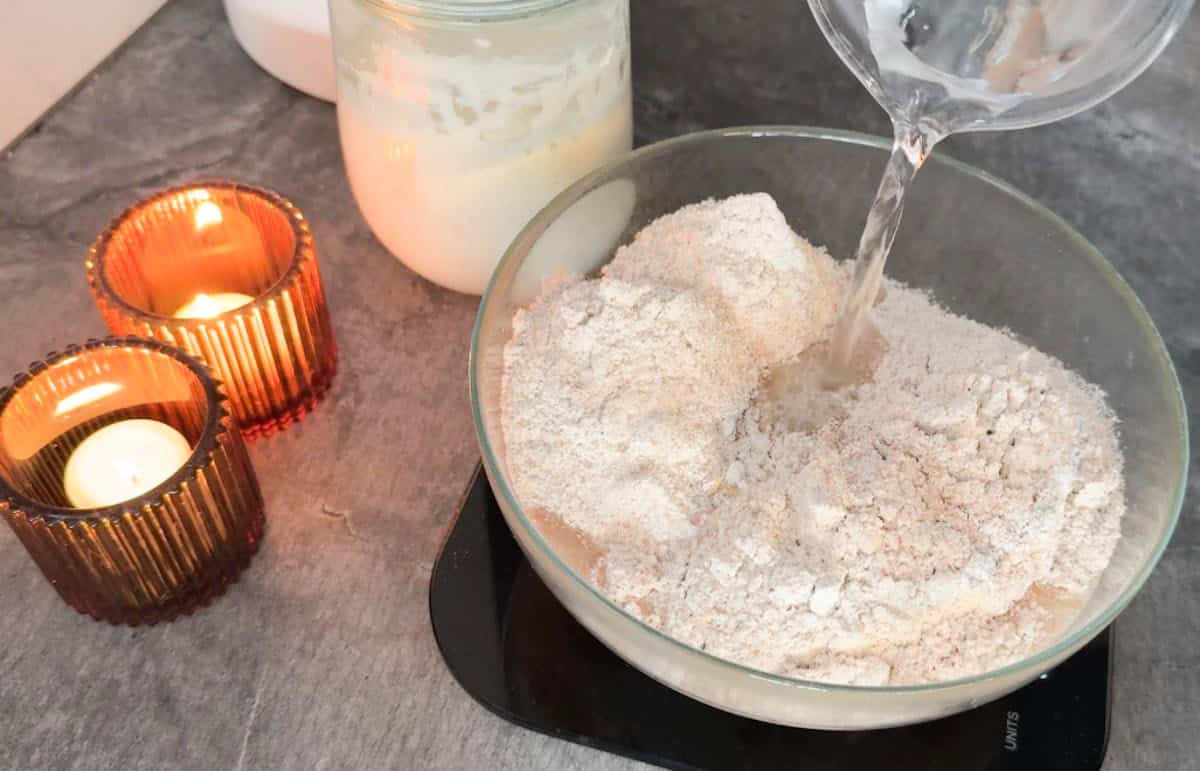
To autolyse, I combine the flour and water in a bowl and mix them just until there are no dry patches left.
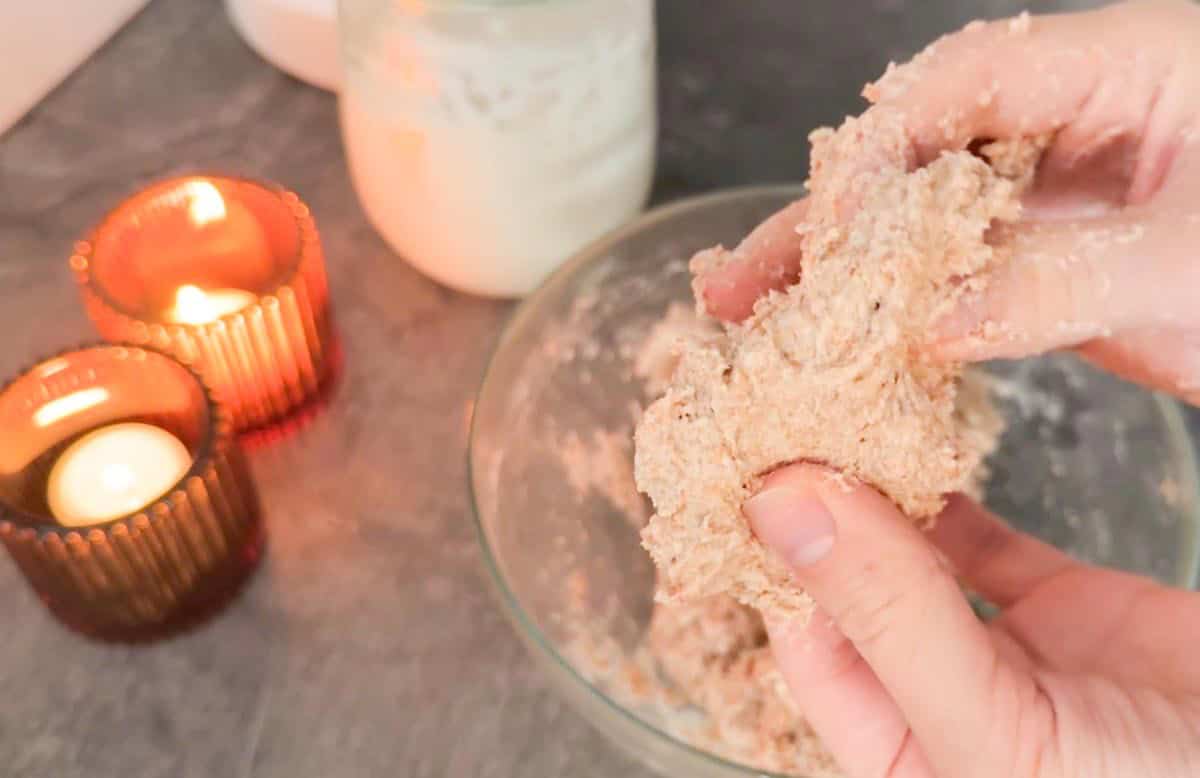
The easiest way to do this is with your hands. I "squeeze" the shaggy dough that forms a few times to make sure all the flour come sin contact with water.
I avoid kneading at this stage because the germ and bran can be quite sharp, especially in fresh milled flour. If you knead too early, those sharp particles can start cutting through the developing gluten before it has a chance to strengthen.
Letting the dough rest first gives the bran and germ time to fully hydrate and soften.
How Long to Autolyse Fresh Milled Flour
I cover the bowl and let it rest on the counter. For fresh milled flour, I usually aim for at least 30 to 60 minutes, and sometimes longer, depending on the grain and how coarsely it’s milled.
Can You Autolyse Fresh Milled Flour Overnight?
Yes, but you must be careful about it.
Fresh milled flour is very active, and a long autolyse at room temperature can push enzyme activity too far. If you leave it overnight on the counter, the dough can become overly slack, sticky, or start breaking down before you even add the starter, yeast, salt or other ingredients.
(Btw, this is how you can make your own fresh milled sourdough starter!)
If you want to autolyse fresh milled flour overnight, the fridge is the safer option. Cold temperatures slow everything down while still allowing the flour to fully hydrate. This works especially well if you’re using very coarse flour or high-bran grains and want extra softness without weakening the dough.
Why Autolyse Alone Can Almost Pass the Windowpane Test
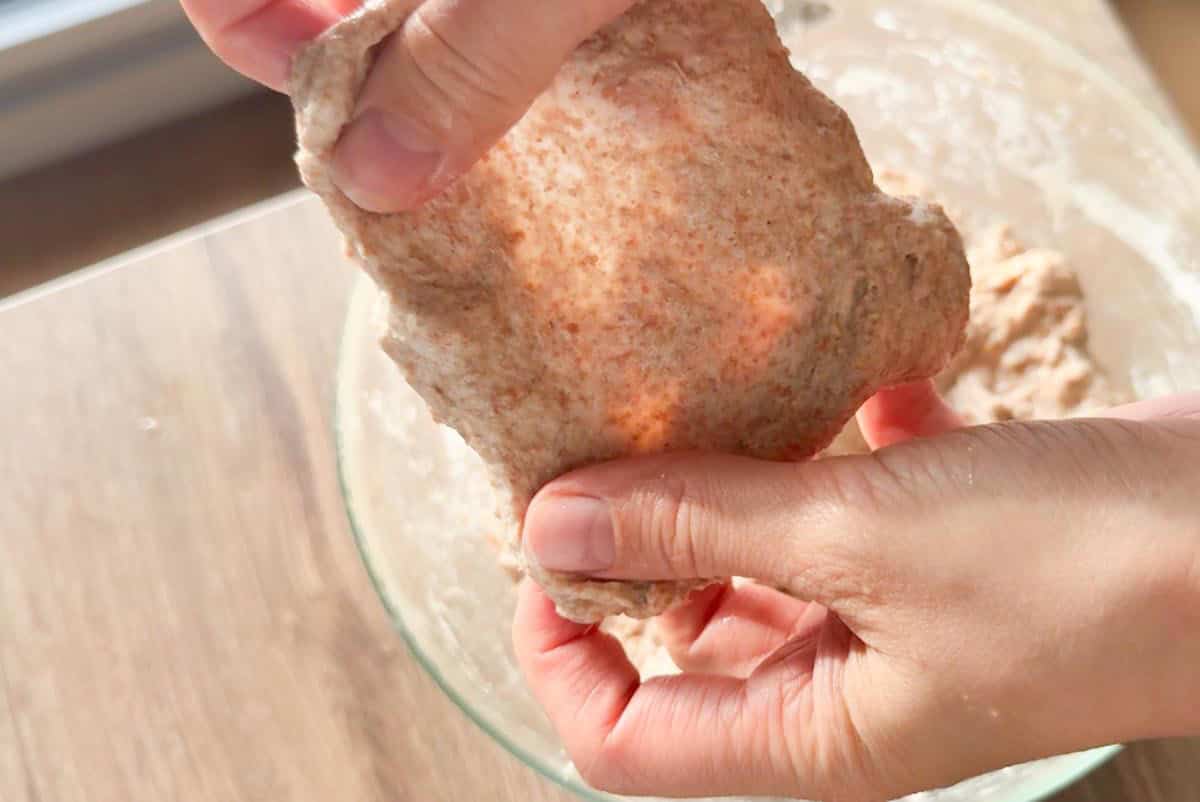
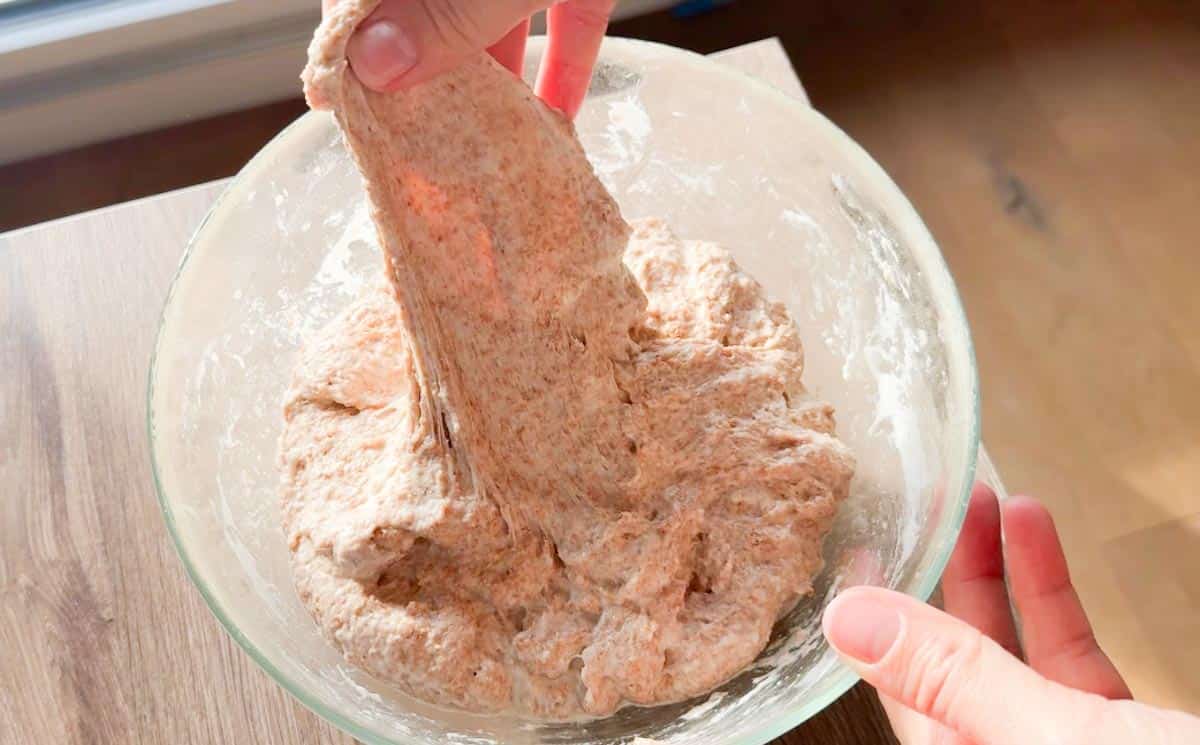
One interesting thing you might notice after autolyse is that the dough already shows some stretch and elasticity, even before any real kneading. If you gently stretch a small piece, it may look like it almost passes the windowpane test, at least if you squint a little!
That’s because autolyse actually allows gluten to start forming on its own, without any mixing or kneading. The proteins have time to align and bond naturally, especially once the bran has softened and stopped interfering as much.
This doesn’t mean the dough is fully developed yet, but it does mean that you'll be able to actually handle the dough without any problems.
What Does Autolyse Do For Fresh Milled Flour?
During this rest, the flour fully absorbs the water and becomes properly hydrated. Even though it looks like nothing is happening, the difference is obvious once you come back to the dough. It feels smoother, more elastic, and much easier to handle.
In short, you won't be dealing with a soupy mess after you properly autolyse your dough!
Fresh milled doughs benefit especially from this step because the softened bran is less likely to tear the gluten structure.
Because the dough develops more strength on its own, it needs less handling later. That means less oxidation and better flavor in the finished bread.
What Does That Mean In Practice?
It means that even if you don't want to bother with the terminology (some of it is explained below), it's really beneficial to leave your dough to rest for at least 30 minutes after you mix it together when you're working with fresh milled flour.
That's all!
It's just a fancy term that describes mixing fresh milled flour with water and letting it rest before adding anything else.
Autolyse vs. Fermentolyse (what’s the difference?)
Autolyse is when flour and water are mixed first and left to rest on their own. This rest gives the flour time to soften, helps the bran absorb water (in the case of fresh milled flour), and allows gluten to start forming naturally. After the rest, the other ingredients are added (starter, salt, and any additional ingredients).
Fermentolyse skips one extra step by adding the sourdough starter (and sometimes salt) right away, so fermentation already begins during the rest.
So ... which one should you do?
In my opinion, the overall result of fermentolyse compared to a "proper" autolyse is only slightly better. Mixing everything at once keeps the process simpler, means you only use your scale once and get your hands dirty once. I think it's worth it to skip a step that only minimally improves the end result!
That said, if you're after picture perfect sourdough and are interested in taking your bread from 97% to 100% perfect (whatever that means to you), autolyse will probably be better option.
Got any questions?
Leave them in the comments below, I check them regularly and I'll do my best to help!

Nina says
I'm trying to make cookies with fresh milled flour and the only liquid in it is eggs. how can I autolyse the flour for cookies? my first batch basically melted flat lol
Tina says
Hi Nina!
I wouldn't worry about autolyse for cookies. The purpose of autolyse is to help with gluten development, and that's something we actually don't want in cookies.
But what fresh milled flour does benefit from is having time to absorb the liquid in the dough. In cookies, that liquid comes from the eggs and butter rather than water. So for cookies, I simply make the dough and let it rest in the fridge for a while before baking. That's already a standard cookie-making step, and it gives the fresh milled flour time to fully hydrate. I often find that helps with texture and spread!
In my experience, a good long rest in the fridge is usually all the "autolyse" cookie dough needs =D
Amanda says
I’m struggling with the autolyse. I’m using fresh milled flour and a sourdough recipe with 77% hydration. When I mix my 400g whole wheat with 385g water it is very stiff! (I left my 100g all purpose out for later) What am I doing wrong? All the pictures I see of the autolyse process, the dough appears very wet. If I add my water to autolyse won’t it become way to wet by the time I add my starter later on??
Thanks!
Tina says
Hi Amanda!
I had the exact same confusion the first time I did autolyse with fresh milled flour, because it really is different from how all purpose behaves. So I get that it feels wrong at first.
Fresh milled flour absorbs water slower, so at the start the dough almost always feels stiff, even at higher hydration like yours. I know that when I'm mixing the dough together, I need a good minute or two to make sure there's no dry flour bits in the bowl, meaning the dough seem VERY stiff right at first. I think that's just normal with fresh milled flour, at least in my experience. But then after the dough rests for about 30 mins to an hour, it becomes a lot less stiff, but it holds itself together better (if that makes sense!).
I think that once, you'll add the starter and remaining flour (100g of all purpose, if I understood correctly?), everything will balance out, and the dough will become easier to work with. Keep in mind that even when the dough becomes less stiff and more wet, the gluten will be developed a lot better by then and it will be possible to work with!
If I were you, I'd just follow the recipe you said you were going to try out. Worst case scenario, it goes bad and way too liquid and you'll know what to do better next time, even if you can't save the first attempt. But from everything you've written, I'd say everything should go smoothly 🙂
Anna C says
Thank you so, so much for your thoughtful reply!!
I’m going to try it both ways - fermenting just the flour and liquid overnight vs making the entire batter and fermenting overnight. We’ll see which gets a better result (both in terms of GI comfort and quality of baked goods).
Our food standards are a little funny - we’d have tons of chemicals that most of Europe bans in their food but we pasteurize anything fermented…just a little contradictory haha.
That’s such a great point about refrigerating - I never thought about it but I whip up a batch of gf df pancakes (lots of egg) and keep it in the fridge for four days, just using some each morning and I’ve never had issues! And that doesn’t include the preserving benefits of sourdough!!
This is such a learning curve for me because I’m having to modify almost every recipe I’m using. I can’t have dairy, I need to eat low-sugar (typically swap for coconut sugar AND reduce the amount), plus adding the sourdough fermenting process haha…I got really good at adjusting paleo recipes but i’m new to fresh milled flour and sourdough. Besides there aren’t a ton of recipes that are BOTH sourdough and FMF!
But, man, being able to eat wheat again is so exciting!!
Tina says
Exactly!
In Europe, unfortunately food standards are lowering too, because most people still look at the price and don't think further about actual food quality, toxicity etc.
It's funny because it's usually the older people who buy more expensive groceries (despite having lower average income!), because they can't get used to the unflavorful processed foods. But on the other hand, I lot of people are "waking up" and I truly hope we can turn this trend around! I have no idea what things are like in the US but considering all the grain mills are always sold out lately it seems like you also have a kind of food renaissance, which is great! =D
I can imagine you cannot wait to have wheat! I know bread is a staple food for me. I would have a hard time adjusting to life without it. I hope some of my recipes help (not all of them are 100% fmf), and I wish you good luck! =D
Anna C says
Hello! I am fairly new to fresh milled flour. I have been making artesian sourdough very successfully and am trying to add some other yummy baked goods (like muffins and cookies).
I have been gluten free for almost 8 years and am so excited about the potential for eating wheat again.
That said, I’m doing great with my sourdough bread, not noticing any of my typical GI symptoms, but I tried some sourdough muffins and they’ve been harder on my system. I’m pretty hopeful that it’s just an adjustment period, but I’m trying to adapt various recipes to help with the adjustment process.
The difference between the muffins and sourdough bread (other than soft vs hard wheat) is the long fermentolyse and the long cold ferment.
If I wanted to add a fermentolyse to my muffin process, do you have any thoughts as to how long I should let it rest? Will it negatively impact the texture of the muffin?
I was contemplating combing my sourdough starter, the FMF, and soymilk/vinegar (df buttermilk lol) for the fermentolyse since the recipe doesn’t have any water.
Any thoughts would be so appreciated!! This is such a learning curve!
Tina says
Hi Anna!
It's nice to know that you can eat sourdough bread without any problems! I'm baking 100% fresh milled bread for a friend of mine who discovered that it's the only bread she can eat. And after several years of not coming near bread, she almost cried when it turned out she actually can have it (if it's 100% fresh milled and long fermented).
I've actually had people ask me about what you're asking multiple times - sort of. A lot of people want to know for example if they can make discard recipes long fermented. And the problem we come to is the same every time: is it safe to let the starter/discard do its job fermenting the batter/dough, without risking the batter spoiling in the meantime? Since there's always some kind of dairy/soy/eggs involved in recipes other than plain sourdough, there's always the dilemma whether it's save to let the batter/dough ferment and potentially risk the batter/dough going bad.
I don't have a straight answer, but I can say this: if you look up food safety rules/instructions, they'll all going to tell you you can't leave any type of batter (muffin batter, pancake batter, cookie dough etc) to ferment for longer periods of time. Even in the fridge. That's because they typically include eggs, milk and things that can spoil. BUT...half the things I make in my kitchen would not be approved by today's food safety rules lol. Most of the traditional foods we eat here ignore them completely (like we'll paint hard boiled eggs for Easter and leave them on the table at room temps and eat them for several days. I've NEVER had a hard boiled egg go bad, and according to the food safety rules, you shouldn't leave them at room temp for more than 2 hours or something silly like that). And I did often make some type of batter/dough, only to realize I don't have time to finish the recipe, and it waited for me in the fridge for a day or two. Or, and this is a really relevant example here: I often make sourdough brioche, that has lots of milk, eggs and butter in it. I always let it ferment at room temp for up to 12 hours. I never had a problems with anything going bad. And then I usually ferment it in the fridge for another 12 hours. I mean, how else will you make sourdough brioche?! I've seen multiple sources state that the acidity of the starter will act against the bad bacteria that could potentially spoil anything else in the batter/dough that's enriched.
Sorry for this little rant, I just get passionate about this lol. So coming back to your situation, and what I'd do I I were you: I think I would be ok with fermenting flour with any liquid the recipe calls for. If I wanted to be extra careful, I'd leave out the eggs for example and reduce the "risk" that way, but just from purely logical perspective and looking at how food has been made for most of human history,...this shouldn't be problematic. If I were you, I'd try to ferment any batter/dough similar to how you ferment sourdough bread, since that's the level of fermentation your body apparently demands: so a few hours on room temp, and then in the fridge overnight, or something like that.
I hope the internet doesn't flag me for this advice, and I cannot recommend this to you officially, but I can say what I'd do, right? 😉
Hope this helps!