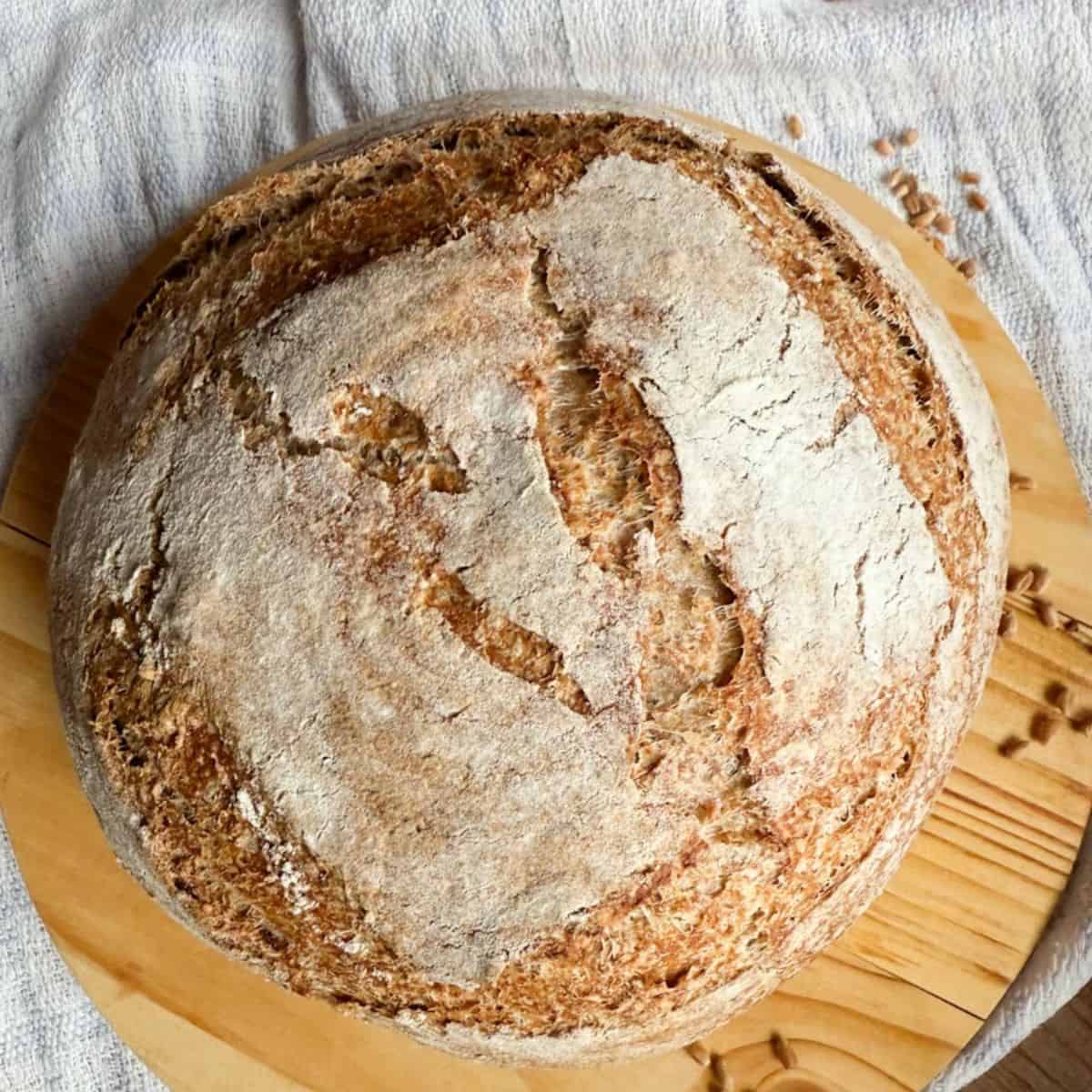
Fresh-Milled Same-Day Sourdough Bread
Ingredients
- 400 g fresh-milled hard white wheat
- 315 g water up to 330 g
- 85 g sourdough starter 100% hydration
- 8 g fine sea salt
Instructions
- In a large bowl, mix the water, starter, and salt until the starter loosens. Add the flour and stir with a spoon, dough whisk, or wet hands until no dry flour remains. The dough will look very soft and loose, this is normal. I usually just use a regular spoon. Cover the bowl with a damp towel or plastic cover.
- Let the dough rest for 30–60 minutes. This helps the flour hydrate and the gluten relax. If the dough still feels tight afterward, work in 5–15 g more water with your hands. The dough should be wet and loose, but not so thin that it drips through your fingers.
- Do 3 sets of stretch-and-folds, about 20 minutes apart. Lift the dough 4–6 times per set, stopping when you feel resistance. Keep the bowl covered between sets.
- Let the dough rise at warm room temperature (23–25°C / 73–77°F) until it grows about 30–50% in volume and small bubbles form around the edges.
- This rise usually takes 6–7 hours, or around 5 hours in a warm spot. Cooler rooms can take up to 10 hours. The timing starts from the moment the starter was mixed into the dough.
- Generously flour your counter. Turn the dough out upside down and gently shape it into a loose ball. Pull the dough toward yourself to build a bit of surface tension. Let it rest uncovered for 15–20 minutes so a thin skin can form.
- Flip the dough over using a bench scraper. Stretch it into a rough rectangle. Fold the top third down, then bring the corners toward the center (“stitching”). Fold the bottom third up, flip seam-side down, and gently tighten the shape by dragging it toward yourself.
- Place the dough seam-side up in a floured banneton or a bowl lined with a floured tea towel. Pinch any open seams. Cover and proof for 1–2 hours, until slightly puffy. This won’t be a big rise. If you're short on time, you can skip this proof, your loaf will still turn out well. (See notes for the cold-proof option.)
- Preheat your Dutch oven to 240°C / 465°F. Invert the loaf onto parchment or a bread mat. Dust with flour if you want a clean scoring pattern. Score the top, use a deep square with shallow decorative cuts if you like.Bake covered for 35 minutes at 240°C / 465°F. Uncover, lower the heat to 230°C / 445°F, and bake another 10–15 minutes until the crust is deep golden. The internal temperature should be 96–99°C / 205–210°F.
- Cool fully on a wire rack before slicing.
Nutrition
Serving1boule
Video
Notes
- Preheat your Dutch oven long enough that the heat can fully surround the loaf and help it spring.
- Same-day sourdough depends on temperature. If your dough is too cool, it will stall. If your kitchen is on the cooler side, use warmer water when you mix up the dough.
-
Private Notes
Tried this recipe?
Please leave a rating!